
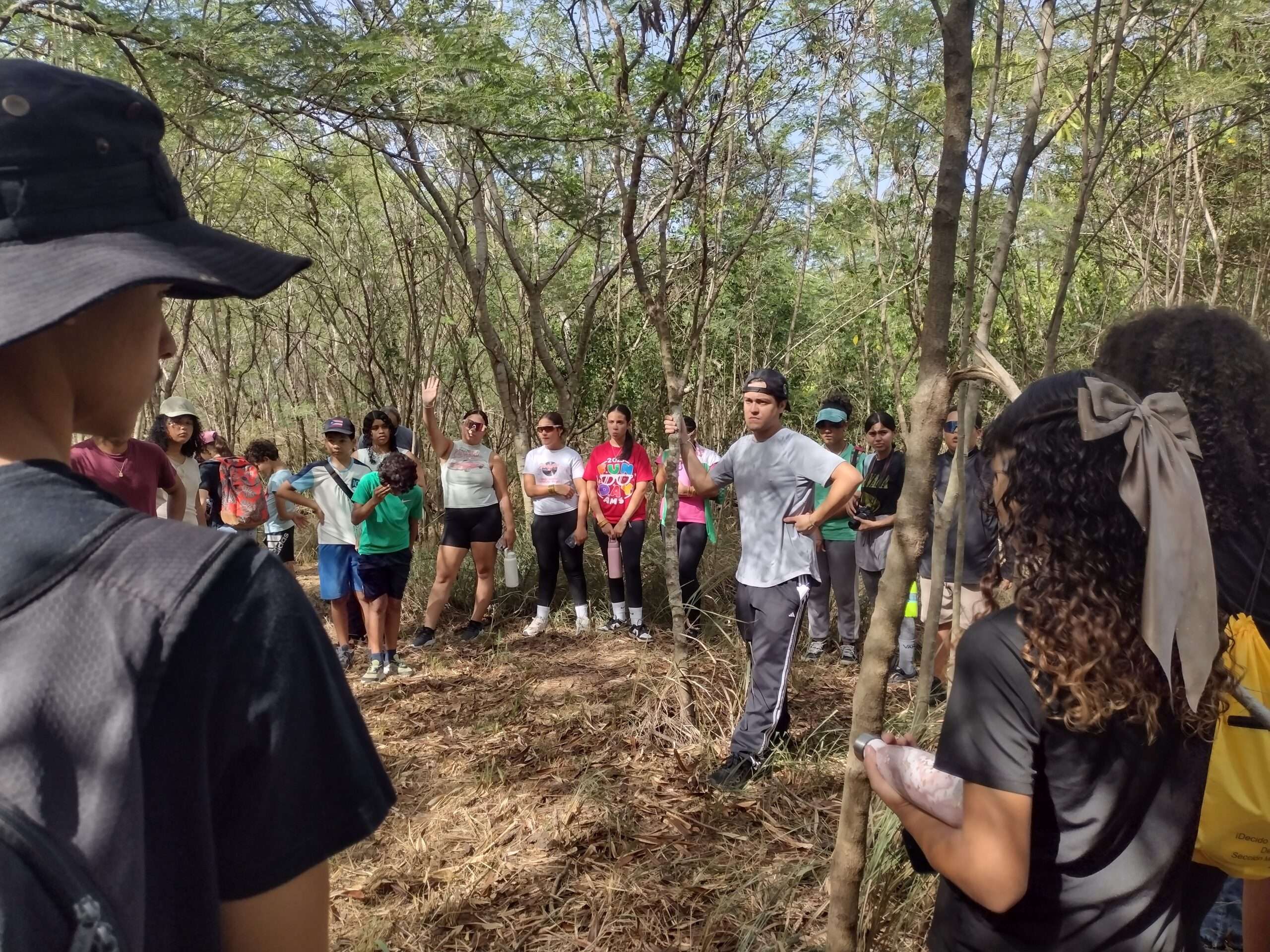
Convivencia Ambiental participants take a guided hike in July 2026. Photo by Catalina de Onís.
This edition of “Gen Z Journal” focuses on the youth leadership of young people—high school and university students—in Salinas, Puerto Rico. Contributors to this blog post include Abdiel Colón Maldonado, Adriana Layz Ledée, Ángel Martínez Díaz, Jerrimar Ortiz, Roberto Y. Ortiz Cruz, Grace Marie Ramos Rodríguez, Evolet Santiago Día, Edwin Gabriel Torres Martínez, and Edwin Lemuel Torres Martínez. I express my gratitude to all of the coauthors of this piece, to the young leaders and their mentors in Diálogo—including Karlai Acevedo Sánchez, Víctor Alvarado Guzmán, Lourdes Ramos Guzmán, Yaminette Rodriguez Sierra, Ruth Santiago, and José Luis (Chema) Baerga Aguirre. Thank you to Attorney Santiago for reviewing and providing comments on the first draft of this blog post.
For 30 years, the Comité Diálogo Ambiental (or Diálogo, for short) has been fighting the poisoning and toxic assault of local residents in Salinas and Guayama in southeastern Puerto Rico. Communities in the coastal area have been exploited for centuries, including by the US sugarcane, genetic engineering (GMOs), and fossil fuel industries. While all of Puerto Rico can be considered a sacrifice zone, areas like the southeast carry disproportionate burdens and confront environmental racism daily. At the same time, community members are building robust alternatives to extractivism and energy colonialism. Indeed, local residents are indispensable guides in co-creating a self-determined, communal present and future–and many are young people.
Diálogo has been involved in several rooftop solar community projects over the years. These initiatives can provide local jobs for residents and create spaces for youth and people of all ages to learn about implementing and maintaining solar technology in ways that fit within the specific needs of the community. Notably, many government- and corporate-imposed projects include “updating” fossil fuel infrastructure to further create reliance on this very unreliable and lethal infrastructure, while also building massive solar farms that often occupy prime agricultural land, destroy habitats of protected species and ecological areas of great value, cause flooding, and prevent local communities from co-creating their own energy just and self-determined present and future. Many community members are showing, by example, how distributed rooftop solar projects are a real solution to address grave climate and energy injustices. On-site power generation avoids the vulnerabilities created by the fragile long-distance distribution and transmission system, which has proven unreliable and, in the case of Hurricane Maria in September 2017, fatal.
In addition to rooftop solar, Diálogo has several interrelated projects that center local youth:
- A digitalization project that preserves, organizes, and documents environmental, climate, and energy justice struggles in southeastern Puerto Rico for the past 30 years. These documents include resistance to the AES-owned coal-fired power plant in Guayama.
- Diálogo recently purchased several cuerdas of land in Salinas to practice sustainable ecological relationships. This “terreno” formerly composed part of the area’s mass sugarcane fields. Today, youth members work alongside their mentors to restore the land. They also are creating an archive that documents flora and fauna found in the area. Thus far, the stewards of this terreno have identified four endemic bird species and numerous other species.
- Every year, Diálogo hosts a well-attended program of workshops and community service for local youth called Convivencia Ambiental. The gathering finds its naming inspiration from the verb convivir, or to co-exist together. Now in its 20th year, Convivencia encourages appreciation and action to care for the beautiful biodiversity and human and more-than-human neighbors of the Jobos Bay region. The multi-day experiences enacted environmental, climate, and energy justice consciousness raising by focusing on air and interrelated issues. Event organizers developed the slogan “Vientos de cambio que respiramos en comunidad.” (“Winds of change that we breathe in community.”) Youth leaders guided the camp and demonstrated intergenerational collaborations in the form of sharing knowledges, desires, and actionable just-worldmaking paths. Activities included an orientation to Diálogo and Convivencia by Víctor Alvarado Gúzman; workshops for designing kites, taking photographs, and making aloe vera and coconut oil lip balm; dancing bomba; painting murals; learning from many presentations by professors, activists, and community leaders, including on air and water pollution; visiting the terreno that local youth steward (mentioned above), which included a visit from two veterinary clinic staff members who taught safety tips for treating dogs well; taking small boats, guided by local fishers, to Cayo Caribe and hiking the area, while collecting precious natural items for a cyanotipo art piece; and growing vetivers, a plant with long roots that helps to minimize erosion and to absorb toxins. Don’t miss the highlights video from this year’s gathering!
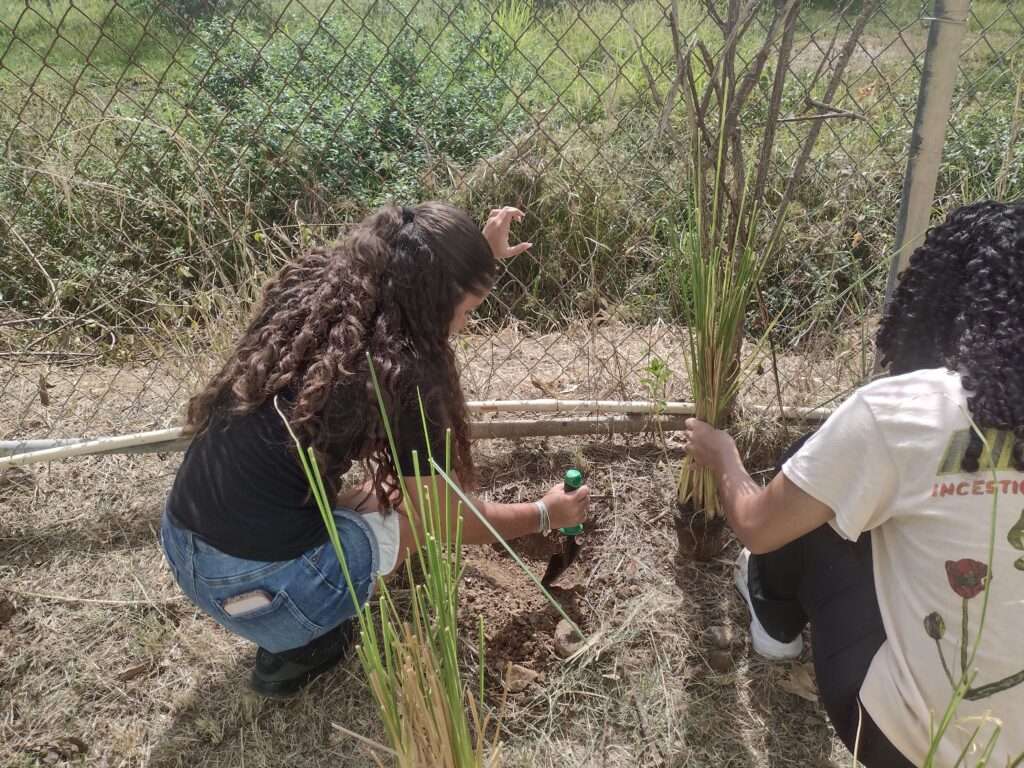
During a hot and sunny afternoon, participants cultivate vetiver plants to minimize erosion in the area. Photo by Catalina de Onís.
As the Communications Lead at JTA, and as a long-time collaborator with Diálogo, I have been honored to work with and learn from these deeply committed, bright, and visionary youth. Below, several involved young people share their reflections:
Why did you become involved in the projects of Diálogo?
“All my life I felt powerless against the situations that threaten the wellbeing of my community. Between natural disasters and political disappointments, it’s natural to lose faith that the situation can improve. I joined Diálogo Ambiental to contribute my grain of sand in the struggle for our island. For me, Diálogo is hope in a critical moment in our history. I feel grateful to be able to form part of such a committed group with supporting, amplifying, and empowering our southern communities, which so many times are forgotten.” -Adriana Layz Ledée
“Initially, I became involved as a participant in Convivencia Ambiental at 12 years old in 2017. By participating in various community gatherings, I gradually became more aware of and learned about the different environmental issues facing my town, many of which directly affect my family and me.
“Over the years, I learned even more about the climate crisis and experienced its effects firsthand—such as hurricanes, droughts, wildfires, and extreme heat. These events made me develop a sense of responsibility for doing something for my people, and I didn’t exactly know how to do it. That’s why I decided to get involved and delve deeper into the projects and initiatives of Diálogo, thereby achieving working directly with the solutions and remedies for the environmental problems that directly affect my people.” -Abdiel Colón Maldonado
“[I became involved] in order to have work experience and because I find their [Diálogo’s] goals and actions to be good.” -Evolet Santiago Díaz
“I decided to become involved with Diálogo principally because Lourdes [Ramos Guzmán] involved me in DIGI. From then on, I became involved because of what the organization and its struggles represent, and that is the reason I decided to stay in Diálogo.” -Edwin Lemuel Torres Martínez
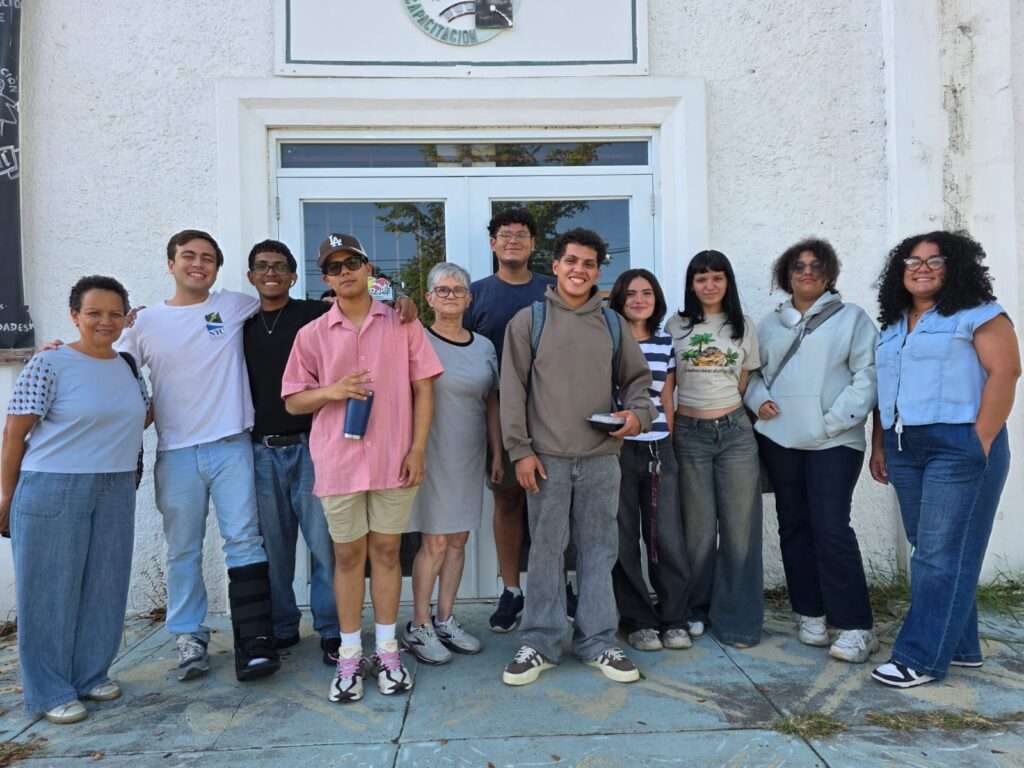
Members of the grassroots digitalization project (“DIGI”) celebrate their last day together in August 2026, after a summer of hard work. Photo by Yaminette Rodriguez Sierra.
“I joined Diálogo since one of the collaborators is someone who knows me, they suggested I attend one of their many programs. That’s how I got to know the team and learned what their cause was all about. I came to realize that the issues Diálogo was fighting for affected me both directly and indirectly, and so I ended up joining this wonderful team.” -Edwin Gabriel Torres Martínez
“I decided to get involved in Diálogo Ambiental’s projects because I have always been interested in learning more about how we can care for and protect the environment. During the 2025 Convivencia Ambiental, I learned a great deal about this topic and had the opportunity to gain firsthand insight into the struggles various communities undertake to defend and protect their environments. Although I was unable to participate in Convivencia this year, I had the chance to attend DIGI for the second time, where I continued digitizing archives related to the history of Diálogo Ambiental’s struggles. This experience allowed me to keep learning and contribute in a different way.
“I would recommend that other young people participate in the next Convivencia Ambiental in 2027. I think it would be a great opportunity to learn more about caring for the environment, to know the experiences of different communities and to understand that we also are able to make a difference. If more young people are interested and join this type of initiative, we could work together to protect our environment and construct a better future for all.” -Roberto Y. Ortiz Cruz
What have been some of the most impactful moments for you and why?
“For me it was a very pleasant and enriching experience. What most impacted me was knowing firsthand the effort and commitment that Diálogo has to protect our environment and to create awareness in the community about environmental injustices that affect our people in Salinas. Also, it was very inspiring to see the interest and enthusiasm of participants for learning and contributing to the care of the environment. I’m taking away new knowledges and the commitment to continue supporting initiatives that benefit our community.” -Grace Marie Ramos Rodríguez
What do you love and/or appreciate about where you live?
“As a Comité Diálogo Ambiental collaborator and resident of the Jobos neighborhood in Guayama, a community located in the southeast of Puerto Rico, my participation in the carried out projects and activities has made fruitful learning about the particularities of my region in the southeast coast of Puerto Rico, especially regarding its ecosystem.
“The species of flora and fauna—and, consequently, the landscapes they create—emerge from a rich and unique ecosystem. They form an irreplaceable panorama; they are found nowhere else in Puerto Rico or the world. Experiencing the unfamiliar sights of other parts of our planet has made me more curious, attentive, and appreciative of my own heritage, driving my desire to continue exploring its protection and conservation, as well as ways to improve the environment.” -Ángel Martínez Díaz
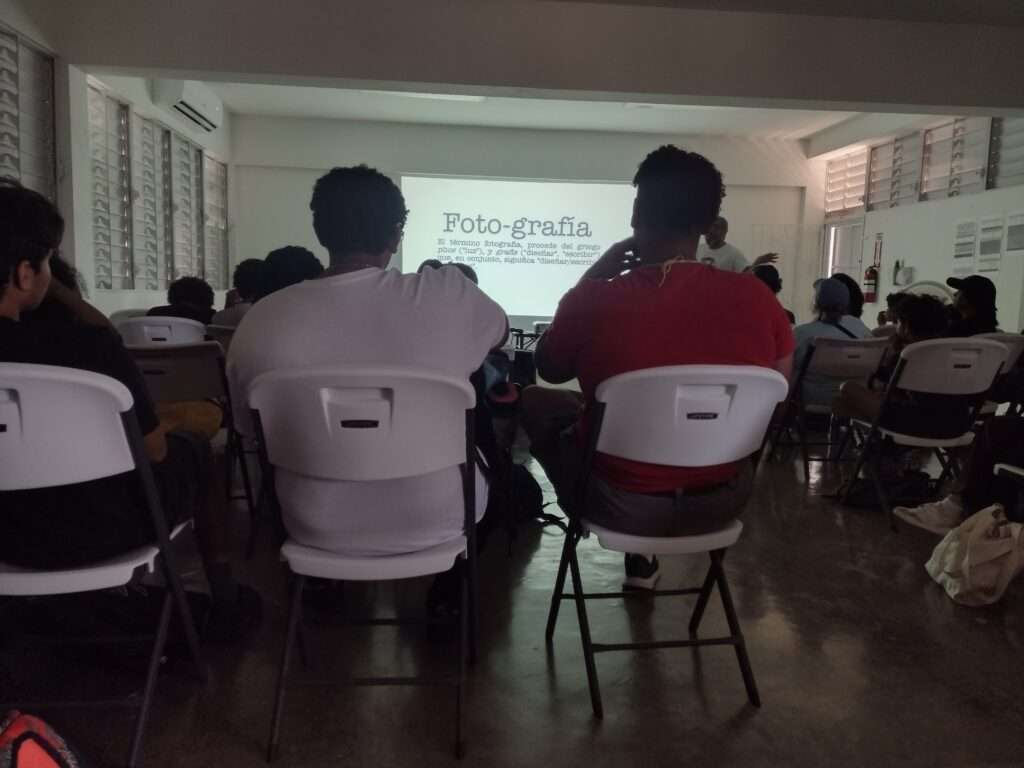
This photography workshop —framed as an important tool for documenting environmental, climate, and energy injustices—was one of several informational sessions held during the camp. Photo by Catalina de Onís.
What would you like to share with other youth about the importance of community work and the key role of young people in advancing and communicating environmental, climate, and energy justice?
“As youth it is crucial we get involved and fight for our future and the future of our communities. To exist is political. I believe it’s imperative that more youth get involved in community work because environmental, climate, and energy justice affect all of us. Real change starts at the community level, and young people have the ability to bring people together, ask difficult questions, and encourage others to get involved. Our generation will live with the consequences of today’s decisions, so it’s especially important that we’re not just part of the conversations but that we also are helping lead them.” -Jerrimar Ortiz